
Acute neck pain can happen after a sudden movement or jolt to our head or body. It may strain the joints, muscles, ligaments, tendons or nerves in your neck or upper back.
Also, pain can arise as part of the normal and natural ageing process.
Neck pain can be categorised into 3 types of neck pain:
- Simple/non-specific neck pain is pain or discomfort in the neck and can sometimes be felt around the shoulders.
- Neck pain with nerve pain is pain coming from the neck that is felt in the shoulder, down the arm and sometimes into the fingers. It can present as burning pain, paraesthesia (pins and needles) or anaesthesia (numbness).
- Whiplash related neck pain is pain in the neck following an acceleration-deceleration injury to the neck such as in a road traffic accident.
How Common Is Neck Pain?
Neck pain is a very common condition; two out of three of us will experience it during our lives. It’s not usually serious and most often eases on its own or with simple treatment within a few days.
In patients who present to Physiotherapy, almost ½ will have some neuropathic factors (pins and needles/ numbness or arm pain)
Causes include:
- Road traffic accidents
- Lifting something heavy
- Sudden coughing or sneezing
- Trips or falls
It can also happen more gradually due to:
- Poor posture (like sitting at a computer for long periods)
- Change in activity (like moving house, or starting a new hobby)
Non-physical factors can also influence your pain such as:
- Emotional stresses: For example anxiety and depression, family or occupational issues can lower your pain tolerance, resulting in you experiencing more pain.
- Lifestyle factors: Such as disturbed sleep, poor diet, lack of exercise/activity and smoking can also contribute to back pain.
What symptoms might I have?
You may experience the following symptoms:
- Neck pain (often spreading to the shoulder, arm, or hand)
- Headaches
- Pins and needles
- Dizziness or nausea
- Difficulty concentrating or remembering things
- Ringing in the ears
- Hearing changes or temporary deafness
Most symptoms are temporary and improve on their own.
Pain may get worse in the first few days. This is normal and happens because of swelling.
Full recovery usually takes up to 6 weeks.
It is important to understand that the pain is not harmful. It is usually short lived and is controllable
What can I do to help myself?
Research shows that an early return to normal daily activities helps you recover faster.
The first Few Days
- Take painkillers for pain relief – Your doctor may have prescribed you some painkillers. Alternatively, your local pharmacist will be able to recommend suitable medicines.
- Try to stay active, even if this means changing the way you do your usual activities at first
- Applying heat packs on the back of your neck can be soothing or alternatively try an ice pack. Wrap the ice pack or heat pad in a tea towel before using, to prevent burns or scalds to your skin. Leave this on for 10 minutes at a time
- Try to sit with an upright posture. If you slouch (sit with your back curved) your chin tends to move forward. This can make your neck feel sore after a while. You may be more comfortable if you support your lower back with a rolled up towel and sit in an upright chair. Get up and stretch regularly.
- Arrange your pillows in bed so there is good support for your neck.
Self-Care and Exercises
Positioning
Lying down with a neck roll can ease pain. You can use:
- a rolled-up towel or magazine
- a rolling pin wrapped in a soft cloth
Place the roll under your neck for short rest periods:
- for headaches: position the roll at the base of your skull
- for shoulder or arm pain: place it lower down the neck
- you may feel the pain in your arm move up toward the neck. This is a good sign.
Try to avoid sleeping with more than two pillows under your head.
Sitting Posture
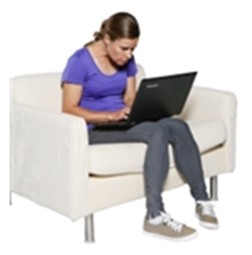
Try to avoid sitting in a slumped position for long periods of time
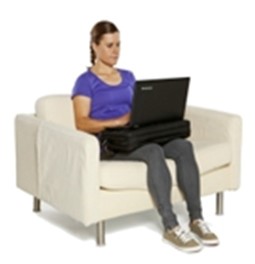
Activity Diary and Modifications:
It can be useful to take note to try and identify which activities aggravate or flare up your neck pain. Below are some common neck aggravators and some possible modifications to relieve discomfort.
| Aggravating Activity | Modification |
| Sustained or repetitive looking up Or poking the chin forward. (e.g. standing on a stool or step ladder, trying to look closely at the computer screen, exercising while leading with the chin) | Take periodic breaks from activity and/or change your position every 20-30 minutes. |
| Sustained or repetitive looking down (e.g. reading a book, looking at phone) | Take periodic breaks from activity and/or change your position every 20-30 minutes. |
| Increased stress and tension | Regular relaxation breaks throughout the day, yoga and walking. Rest your arms on a high counter or table, or on two cushions over your knees. |
| Reaching, lifting and other arm movements | Move closer to the object you are trying to reach, use both arms to distribute the weight of the object or use the other arm until your pain improves. |
| Sleeping | Arrange the pillows to have enough support for the neck and be at neutral height (not too thick or too thin) |
Exercises
Gentle exercises can help reduce pain. Do them frequently throughout the day, especially when your pain is active. Take pain relief if needed to help you move more comfortably.
Start slowly and increase your range of movement gradually as pain allows.
- Tuck your chin and push head gently back feeling a stretch of muscles in the back of the neck. Do this 10 times.

- Hold the back of your head with one or two hands, and tip it backwards 10 times as far as you are able. Stop if this exercise always makes you feel dizzy and see your GP.
- Sit or stand upright with good posture. Rotate your neck slowly to the left by looking over your left shoulder. Take your neck to a comfortable end of range. Repeat to the right. Make sure you keep your shoulder and back relaxed. This is an excellent exercise to improve rotation and mobility in your neck.
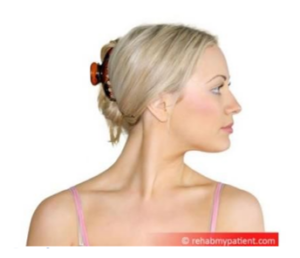
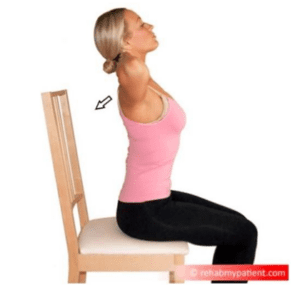
- You might find it helpful to also sit in a low backed chair and stretch the middle of your back over the chair back, raising your chest slightly. This is usually helpful for pain between the shoulder blades or around the ribcage. If this always makes you dizzy and see your GP. A stretch feeling is not harmful, or causing damage and will slowly improve.Maintain as much range of movement in every direction as possible. It is normal to feel a stretch of muscles as they tend to tighten if not moved to full range of movement. Use your neck as normally as possible during the day. A stretch feeling is not harmful, or causing damage, and will slowly improve.
https://www.oxfordhealth.nhs.uk/wp-content/uploads/2014/08/OP-153.15-Neck-exercises.pdf
https://www.royalwolverhampton.nhs.uk/wp-content/uploads/2025/06/Neck-Exercises.pdf
Keeping the nervous system moving
To keep your spine and nerves moving, sit on a bed or a chair that allows your legs to swing freely. Straighten one leg out in front of you, then bend it again. Repeat with the other leg. Do 20 rhythmic swings with each leg.
If you feel a gentle pull in your neck, middle back, or lower back, do the exercise gently twice a day until you no longer feel the pull.
Sitting Supported
When you sit for long periods, especially while traveling or working at a desk, it’s important to maintain the natural curve in your spine. To do this, roll up a towel or cushion and place it in the small of your back. Sit back into your chair to avoid straining your lower back. Try to stand up and move around as often as possible to keep your body comfortable and prevent stiffness.
Try to avoid
- Long periods of bed rest
- Wearing soft neck collars
- Relying heavily on muscle relaxant tablets
Work
It will help speed up your recovery if you stay or return to work as early as possible. Do not worry if you are still experiencing neck pain as you may only be required to do light duties at first.
Trying to maintain normal activity and regular movement while applying the necessary modifications to make tasks more manageable can be very important for recovery. Speak to your manager about any concerns you might have.
When to get urgent help
Call your GP or return to A&E immediately if you notice:
- loss of control over your bladder or bowels
- pins and needles in both arms or both legs
- numbness in your genital area or back passage
- muscle weakness, poor balance, or difficulty walking
- sexual dysfunction.
These could be signs of something more serious.